01
Upper Arch Preparation, Keyhole Sinus Lifts & PRF
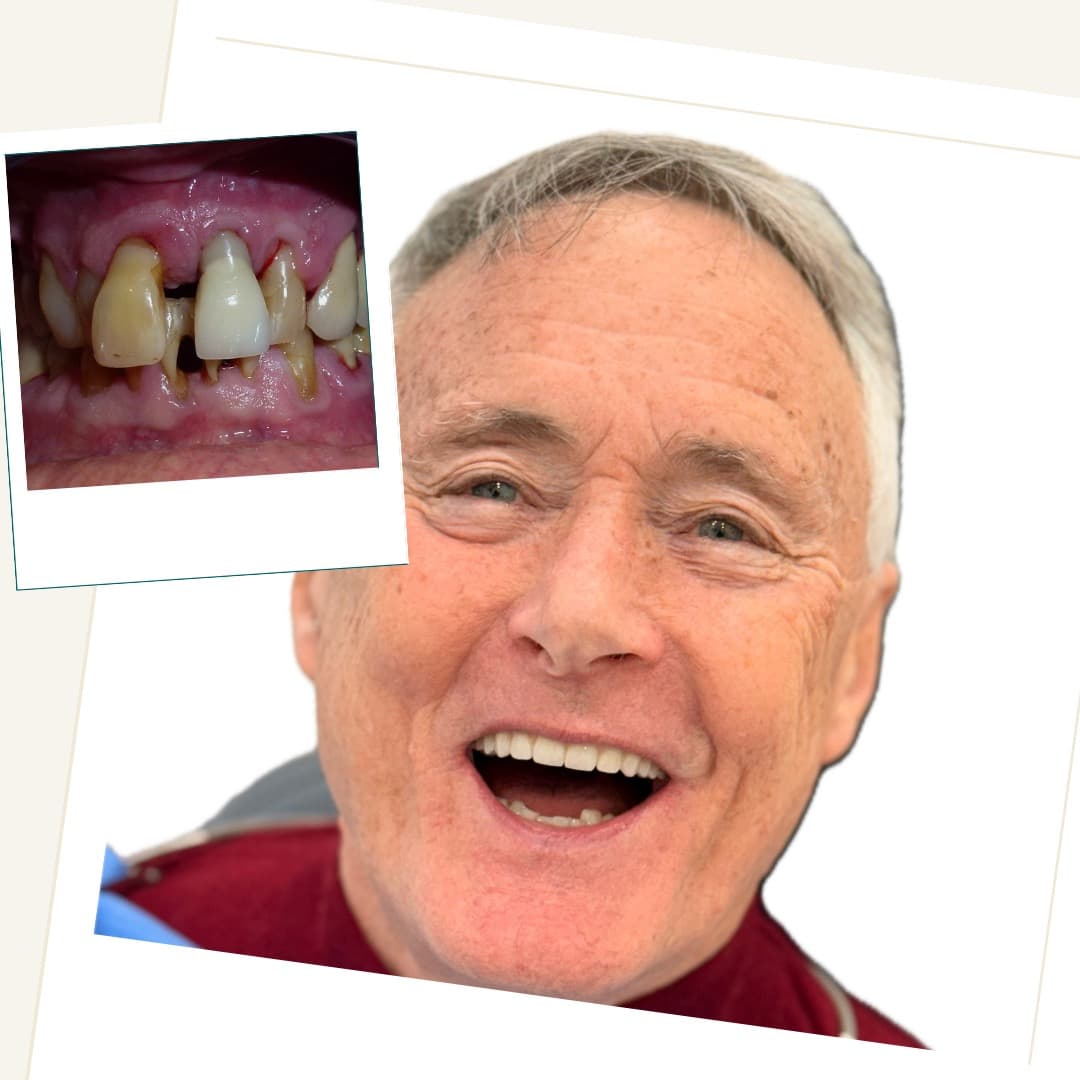
To establish a robust full-arch foundation, the three existing upper implants were evaluated and confirmed to be fully integrated and healthy. To incorporate them seamlessly into the new treatment plan, their historical abutment connectors were updated to match the new bridge architecture.
Three additional implants were strategically placed to achieve a balanced All-on-6 network. Due to localized bone resorption in the posterior regions, a specialized, minimally invasive keyhole sinus lift technique was executed to elevate the sinus floor membrane.
Premium bone graft materials alongside Platelet-Rich Fibrin (PRF) membranes—centrifuged directly from the patient's own blood—were deployed to support rapid bone density regeneration, protect the site, and accelerate early soft tissue healing.
02
Immediate Loading: Upper Same-Day Acrylic Bridge
Utilizing precise pre-operative metrics and digital spatial measurements, a high-density provisional acrylic bridge reinforced with an internal implant bar for extra strength was prepared.
On the exact day of the surgical intervention, this custom temporary bridge was securely fitted and screwed directly onto the six upper foundations. This 'same-day teeth' framework protected the surgical sites, maintained immediate phonetic and chewing function, and instantly restored the patient's cosmetic confidence during the required six-month osseointegration healing phase.
03
Lower Arch Staged Extraction & Immediate Placement
The lower arch required a localized, multi-vectored approach to address broken and worn central incisors and a missing lower right first molar (LR6). Following the careful removal of the non-restorable lower central teeth, a single dental implant was immediately placed into the extraction site.
This single fixture was engineered to support a 2-unit splinted bridge setup, conservatively replacing both missing central incisors. Concurrently, an immediate implant was placed into the LR6 extraction socket, combined with a premium xenograft bone substitute to preserve the bone contour.
The lower arch implants achieved complete stabilization within a brief 3-month healing window, allowing their definitive restorations to be custom-fitted and delivered earlier than the upper arch bridge.
04
The Final Definitive Upper Zirconia Bridge
Following the verified six-month healing and muscle adaptation period, the temporary upper bridge was removed. The six implant foundations were evaluated and confirmed to be structurally sound and completely integrated.
The definitive full-arch restoration was delivered: a custom-engineered, premium extra-strength zirconia porcelain bridge. This definitive prosthesis was meticulously screwed in, establishing an optimized bite alignment, highly symmetric tooth contours, and a durable structural profile.
05
Long-Term Prosthodontic Maintenance & Defence
Given the historical presence of periodontal issues and heavy bite forces, a strict long-term maintenance roadmap was deployed. The patient was placed on a recommended three-month professional hygienist and prosthodontic review schedule to monitor the tissue margins.
Following full bite stabilization, a custom nightguard was fabricated to insulate the zirconia restorations from subconscious clenching forces, and the patient was instructed to avoid heavy direct impacts on exceptionally hard foreign objects.